Site Search


Contact: Mr Yuan
Mobile:18822809251
Tel:+86-0755-2314670
QQ:2144782477
e-mail:szhsxpcb@126.com
Address:No. 1 Xinhe Avenue, 8th Industrial Zone, Gonghe Community, Shajing Sub-District Office, Bao'an District, Shenzhen .
Introduction
The back drilling of a via is an advanced form of PCB fabrication that is commonly used in high-speed and high-frequency applications for the management of via stubs to improve signal integrity. A via stub is an unnecessary part of a plated through hole (PTH) that is completely not part of the path of the signal often causing problems such as some signal reflections, change in the impedance of the circuit, electromagnetic interference (EMI), etc. In scenarios, when there is a need to transmit a signal whose frequency is greater than 1 GHz, drilling is often employed to maintain operational efficiency and prevent data transmission errors.
What is Back Drilling?
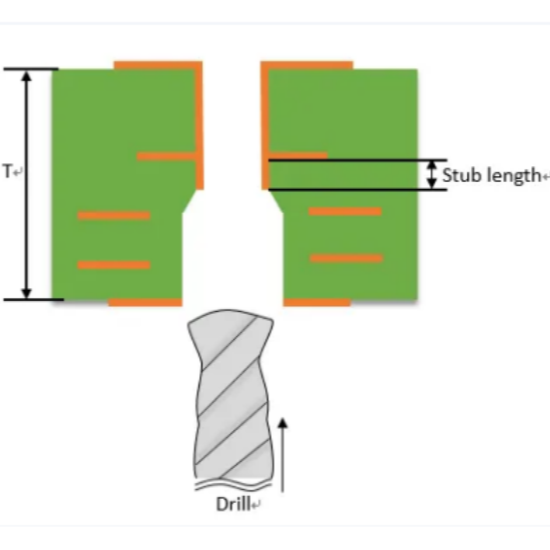
Back drilling is usually known as controlled depth drilling because it involves drilling out the sub, that is via stubs, through the other side in order to a specific depth of the board. This removes a stub that can receive and radiate electromagnetic interference which would have been detrimental to signal transmission. This will help manufacturers control the loss of signals when layers of the PCB are connected through the drilled holes.
Why Do We Need to Back Drill PCBs?
Back drilling has become an integral process of PCB fabrication, more so in high-speed and/or high-frequency applications. Here are the key reasons why back drilling is essential for PCB designs:
Eliminating Signal Integrity Issues
Via stubs which are the unnecessary sections of PTH that closely extend from the signal layer, tend to introduce signal reflection and impedance mismatches. Such reflections are detrimental to actual signals concerning quality, particularly in high-speed systems with frequencies usually greater than 1GHz. These reflections can be reduced by eliminating the via stubs through back drilling eliminating noises from signal paths hence enhancing signal integrity.
Reducing Electromagnetic Interference (EMI)
Unintended via stubs can also act like antennas sending off more electromagnetic energy than required to other areas disrupting other components and demanding more EMI. In telecommunication and aerospace industries that have stringent electromagnetic compatibility (EMC) protection, EMI must be kept low at all costs, to protect the signal from degradation. The back-drilling process removes the portion of the via responsible for this EMI action making systems stop suffering the adverse effects of EMI. Supporting High Data Transmission Rates
Most applications in computing networks like networking and telecommunications have data transfer rates that are over 1Gbps. Signal paths can be obstructed by vias which can in turn decrease the bandwidth of the signal being transmitted. This has made it possible to increase the data rates but lowered the chances of bit errors occurring. This is particularly critical for those designs where reliable transfer of data at very high speeds is paramount.
Improving PCB Design Flexibility
Back drilling is an enabling technology in the sense that it is possible to have less use of blind or simply buried vias, which eases the build of up multi-layer PCBs without losing the quality of high-speed circuit signals. This capability helps achieve crowded layouts without affecting the performance, which is very important in small, high performing devices such as smartphones, routers or servers.
Cost-Effective Solution for High-Speed PCBs
Compared to solutions such as using blind and buried vias or sequential laminations, back drilling as a solution for improving signal integrity is normally cost competitive. It encourages a simplification of the design and manufacturing process, more so in high density PCBs whilst still meeting the functionalities required in high-speed high frequency operations.
The Back Drilling Process
Back drilling is a delicate process necessary for avoiding the build-up of excessive material on the vias in PCBs particularly for high-speed applications where integrity of the information being transmitted is of paramount importance. The process of back drilling is presented in detail below:
Initial Via Drilling
The process starts with an ordinary drilling of the through holes, generally referred to as vias. These vias are drilled completely through the entire board so that there is a circuit formed between multiple layers. Once the drilling is complete, the vias are covered with copper to establish the required electric connections. It is very important to do copper plating since the signals ought to be passed even in the inner layers of the PCB.
Patterning and Plating
After the drilling has been performed, the outside layers of the PCB are subjected to a patterning process in which the circuitry that is required is made. After this, copper is plated in the side walls of the vias to create conduction paths in between the layers of PCB that allow signal flow. This step ensures the creation of outer layer circuitries that bridge the vias for the connection of electrical work on the board.
Back Drilling
Back drilling is a unique technique that employs CNC machines with specific controlled depth drill bits. The technique is used to eliminate the non-operational section of the via known as the stub. The drill bit does not drill beyond a certain depth, ensuring that the stub is removed while the visa and its connectors remain connected to the signal layers. In the end, the signal connection is cleaned without the stub causing the short circuit between the signal layers.
Inspection and Cleaning
After this back drilling activity has been accomplished, the board is subject to diagnosing correcting work so that the visa has been drilled out appropriately located and appropriately deep. Automated Optical Inspection (AOI) has become one of the solutions employed to examine the quality of the back-drilled via. Moreover, the board is also washed to clear off some of the drilled chips that may have stuck. This step is very important in enhancing the performance and reliability of the PCB.
Applications of Back Drilling
Back drilling is an essential process especially in industries that emphasize high data transmission and high signal integrity. Let us take a look at the various sectors where the back drilling technology has found applications:
Consumer Electronics
Smartphone, tablets, wearables and similar devices are increasingly becoming small but require high data transfer speeds and good signal quality. Back drilling endorses optimization of signal paths by removing via stubs which act as rough edges in a signal in cases of signal-intensive ‘overcrowded’ designs. Thus, efficient and dependable performances are achieved as small and powerful devices are hardly any longer a dream.
Telecommunications
In the case of the telecommunication infrastructure particularly that of the 5G networks data has to be transmitted at all times and at very high speeds so as to avail the much-needed quality of fast communication. Back drilling helps rectify this problem by lowering electromagnetic Interference and signal reflections due to via stubs, thus allowing for a cleaner unimpeded signal transmission. There is enhanced performance of the network in terms of reduction of transmission errors hence it will be useful in constructing the communication systems of the future.
Aerospace and Defense
Electronics in the Aerospace and Defense sectors are required to be of high performance and to be operational even within severe circumstances. Avionics equipment on board an aircraft or military communication systems make use of a technique called back drilling, which is efficient in maintaining signal integrity because stubs that interfere with signals at higher frequencies are removed. Such systems are critical in situations where there is a high level of trust in the information being provided and covering extreme environmental bunters.
High-Performance Computing
In a data center, supercomputers as well as other high-performance computing systems, an ultra-fast comparative data processing feature is required. In these scenarios, back drilling assists in optimizing the signal paths of the PCB layout such that the via stubs that may affect high-speed operation of the system are cut out. This improves the luminal capacity as well as processing capabilities of data systems enabling them to function optimally in situations where the performance capacity is put to the maximum.
Design Tips for PCB Back Drilling
In designing a PCB, there are design tips that one may consider to eliminate issues that are encountered when working and manufacturing the PCB:
Minimizing Via Stubs
It is essential to place signal routes on layers where the distance of the via stub is the shortest possible when designing for high-speed applications as this usually leads to better performance. Shorter stubs help reduces signal reflections and eradiation. Also, when back drilling has to be performed, it is better to avoid the use of blind vias as they usually complicate the operation.
Optimal Via Placement
Vias should be placed in a way that tolerable Q factor is not disturbed. Make sure there is adequate separation distance between the backs of drilled vias and trace, which is for fear of interference. Proper spacing also enables the structural integrity of the system when the drilling is being done.
Maintaining Impedance Control
when back drilling is executed, the trace lengths around the drilled areas must be reduced in compliance with the displacement of the resistance level or compensation loop. There are minimal problems such as signal reflections or losses that can occur. This since the signal is not interrupted and terminated is basic and especially critical when dealing with fast designs.
These design strategies help ensure that back drilling enhances PCB performance without causing unintended interference or degradation.
Challenges and Considerations
Despite these advantages, back drilling is sometimes too complicated for the manufacturing process because it also requires a lot of factors to consider. It also involves the proper use of specialized apparatus such as high precision CNC drilling machines and a degree of depth control to avoid infringement of the neighboring circuits. Signal integrity simulation in the form of acoustic TDR is often done to ascertain if back drilling is a necessity for certain designs.
Choosing the Right Partner
Back drilling is an essential operation that helps improve the signal integrity of high-speed, multilayer PCBs. It allows the designers to develop more intricate and dense design boards without compromising on performance. It is of special importance in multi-layered PCBs where this enhances the reliability and performance of systems. The process of back drilling is not just a routine thing since it requires expertise and due process. Picking the appropriate fabricator with strong technology like FS is important since this is the only way to improve depth control as well as signal integrity. Also, choosing a back-drilling manufacturing partner with expertise ensures that the customer back-drilling process is completed efficiently and at lower prices.
+8618822809251
Website:www.huashing-pcb.com
Address:No. 1 Xinhe Avenue, 8th Industrial Zone, Gonghe Community, Shajing Sub-District Office, Bao'an District, Shenzhen .
